Fallback e-mails & activity log
When something goes wrong during a submission — an integration rejects the data, an API times out, a payment doesn't come back — the submitted data would otherwise be lost. This feature keeps a record of it: selected events are written to an activity log in the database, and can also be sent to you as a plain-text fallback e-mail with all the submitted data, ready for debugging or manual processing.
How to use it
Enable the feature in the global settings, under Troubleshooting → Fallback e-mails, then turn on Enable activity log. The rest of the options only show up once the log is enabled.
Activity log
Every logged event is stored in the database, along with the form it belongs to, the debug key that describes what happened, the originally submitted parameters and the integration's response. The visitor's IP address is hashed, never stored in plain text.
Logs can be browsed from the WordPress admin — all of them at once from the feature's settings, or only the ones belonging to a single form from that form's Fallback settings.
Auto-delete
Turn on Auto-delete old activity logs and set a retention interval in days (30 by default) to keep the table from growing indefinitely. The cleanup is done by a daily cron job.
Fallback e-mail
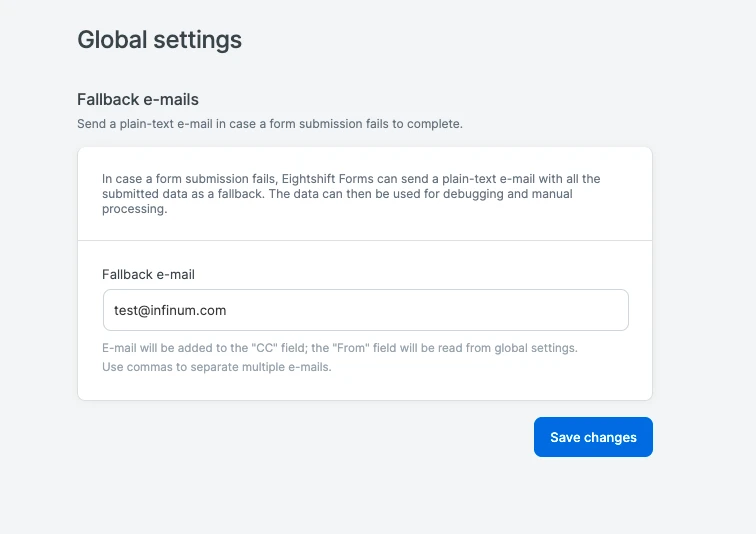
The Fallback e-mail field in the feature settings receives the e-mails for every logged event. Multiple addresses can be used by separating them with commas.
Each integration also has its own Fallback e-mail tab in the global settings, so a specific integration's failures can reach additional people. Those addresses are added as CC — or become the main recipient if no global fallback e-mail is set.
If neither address is set, no e-mail is sent. The event is still written to the activity log.
The e-mail is sent as plain text and contains the form title and ID, the debug key, the ID of the matching activity log entry, and the submitted data.
Log level
The Log level option controls how much debug data is included in the e-mail:
- Minimal — only the debug key, so you know what happened without the payload.
- Default — the debug key plus the submission and integration response details, with the bulky form definition data (field lists, steps setup, file metadata) stripped out.
- FULL MAX — everything the request produced, the raw request included.
FULL MAX e-mails contain the complete submission. Use it while debugging, not as a permanent setting, and keep in mind who receives those e-mails.
Events
Not everything is logged by default. The settings list the available events grouped by type — general submission errors, validation problems, per-integration failures, and so on — each with its own toggle and a short description of when it fires. The ones we suggest keeping on are marked as recommended.
Only the events you enable produce an activity log entry and a fallback e-mail, so you can start with the recommended set and switch on more while chasing a specific problem.
Fallback e-mails and activity logs contain data submitted by your users, so this needs to be disclosed in your privacy policy, and the retention interval should match your data retention rules.